Capacitors, fundamental components in electronics, store electrical energy. But just like different units measure distances, capacitance is expressed using various units like picofarads (pF), nanofarads (nF), microfarads (μF), and farads (F). Understanding how to convert between these units is critical for anyone working with electronics. Additionally, a capacitor converter involves switching capacitors to achieve voltage transformation, a clever technique seen in many modern devices like phone chargers and power supplies. This article will guide you through these conversions and their uses, making the world of electronics a little easier to grasp, much like how we use miles vs kilometers in our daily lives.
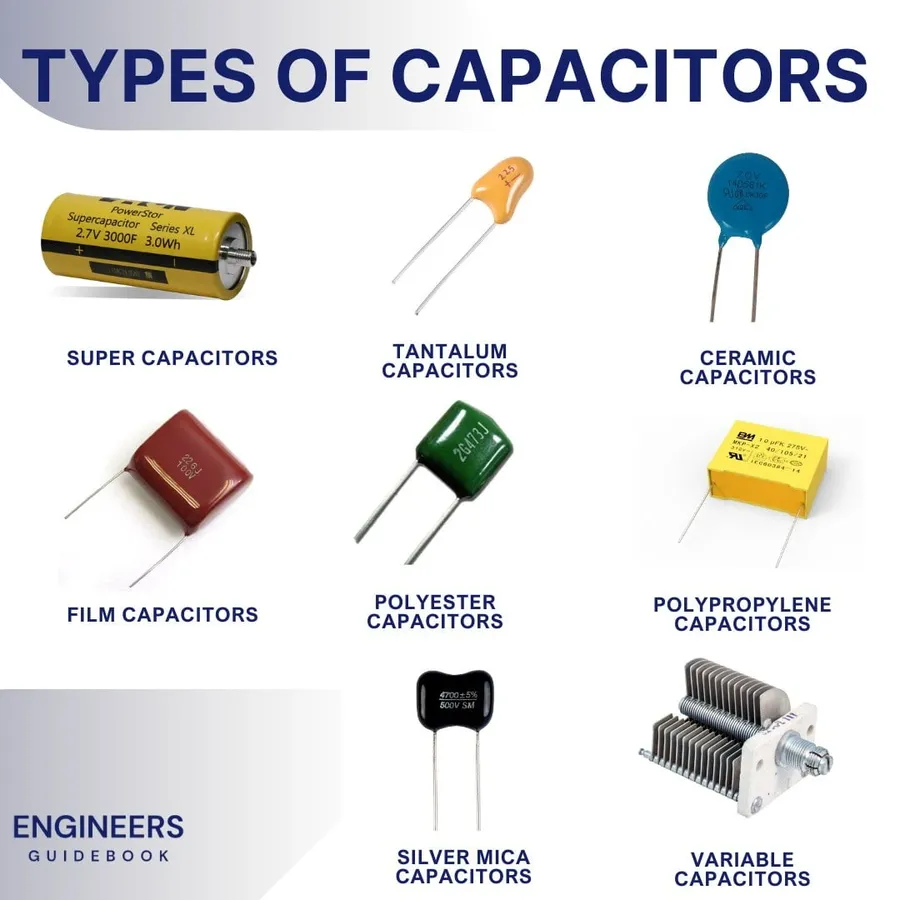
Capacitance, the ability of a component to store an electrical charge, is measured in Farads (F). However, a Farad is a very large unit, so in practical electronics, we commonly encounter smaller units: picofarads (pF), nanofarads (nF), and microfarads (μF). Understanding the relationships between these units is crucial for anyone working with electronic circuits.
| Unit | Abbreviation | Value in Farads (F) | Analogy |
|---|---|---|---|
| Picofarad | pF | 1 x 10^-12 F | Like a tiny droplet of water compared to a large pool |
| Nanofarad | nF | 1 x 10^-9 F | Like a small cup of water compared to a large pool |
| Microfarad | μF | 1 x 10^-6 F | Like a small bucket of water compared to a large pool |
| Farad | F | 1 F | Like an Olympic sized swimming pool |
To illustrate, imagine filling a container with water. The amount of water the container can hold is analogous to capacitance. A picofarad capacitor is like a very small container, a nanofarad capacitor is a bit larger, a microfarad capacitor significantly larger, and a Farad capacitor is enormous. Each step up in scale is a thousand-fold increase, which means 1 nF is 1000 pF, 1 μF is 1000 nF, and 1 F is 1,000,000 μF.
Capacitor conversion is essential in electronics due to the varied ways capacitance is specified and the practical needs of circuit design, component selection, and repair. The necessity arises from the diverse range of capacitance units used (picofarads (pF), nanofarads (nF), microfarads (µF), and farads (F)) and the need to interpret datasheets, ensuring proper component matching during manufacturing, design and repair processes.
For example, a capacitor might be listed as 2200 pF on a schematic, but a parts supplier may only list available parts in nF or µF. Therefore, it would be essential to convert 2200 pF to 2.2 nF or 0.0022 µF to find a suitable component. Similarly, datasheets from different manufacturers might use different units, making direct comparison difficult without proper conversions. This demonstrates that unit conversions are not just theoretical exercises but crucial practical requirements for a functional system.
Consider a common application such as a smartphone circuit. Designers often work with values in pF for high-frequency circuits and in µF for power supply decoupling. To combine these components in a single circuit requires accurate conversion between units to calculate the effective capacitance and ensure the circuit behaves correctly. Repair technicians also encounter this when replacing parts or analysing circuits. Without a clear understanding and facility with unit conversion, it becomes extremely hard to correctly troubleshoot the issue or replace components correctly. Thus, facility in unit conversion is crucial for working with electronic circuits and components.
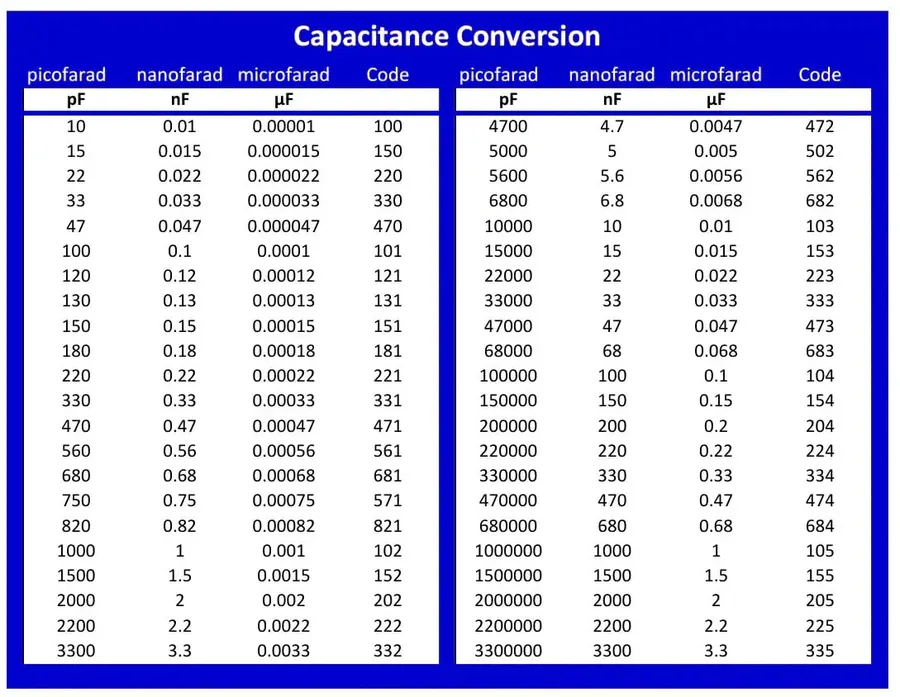
Capacitance values are expressed in various units, most commonly picofarads (pF), nanofarads (nF), microfarads (µF), and farads (F). Converting between these units is essential in electronics for design, analysis, and component selection. The conversions are based on powers of ten, where each unit represents a multiple of the base unit, the farad.
| Conversion | Formula | Example |
|---|---|---|
| pF to nF | nF = pF / 1000 | 1000 pF = 1 nF |
| pF to µF | µF = pF / 1,000,000 | 1,000,000 pF = 1 µF |
| pF to F | F = pF / 1,000,000,000,000 | 1,000,000,000,000 pF = 1 F |
| nF to pF | pF = nF * 1000 | 1 nF = 1000 pF |
| nF to µF | µF = nF / 1000 | 1000 nF = 1 µF |
| nF to F | F = nF / 1,000,000,000 | 1,000,000,000 nF = 1 F |
| µF to pF | pF = µF * 1,000,000 | 1 µF = 1,000,000 pF |
| µF to nF | nF = µF * 1000 | 1 µF = 1000 nF |
| µF to F | F = µF / 1,000,000 | 1,000,000 µF = 1 F |
| F to pF | pF = F * 1,000,000,000,000 | 1 F = 1,000,000,000,000 pF |
| F to nF | nF = F * 1,000,000,000 | 1 F = 1,000,000,000 nF |
| F to µF | µF = F * 1,000,000 | 1 F = 1,000,000 µF |
These formulas illustrate the relationship between capacitance units. For instance, to convert from a smaller unit like picofarads (pF) to a larger unit like microfarads (µF), you divide by one million (1,000,000). Conversely, to go from microfarads (µF) to picofarads (pF), you multiply by one million (1,000,000).
Understanding these conversions is crucial for working with datasheets and designing circuits. The table above provides an easy reference for common conversions. For manual calculations, carefully apply the formulas, paying close attention to the powers of ten.
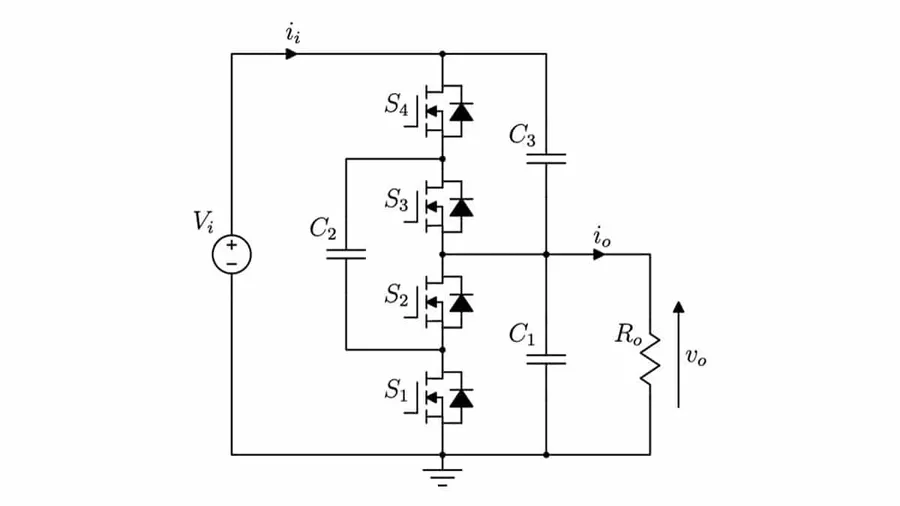
Switched capacitor voltage converters, also known as charge pumps, represent a highly efficient and compact method of DC-DC voltage conversion, leveraging capacitors as the primary energy storage element rather than inductors. Their operation relies on the controlled switching of capacitors to transfer charge, thereby altering the voltage level. This approach significantly enhances energy efficiency, particularly in low-power applications, and simplifies design by eliminating the need for bulky inductors, making them ideally suited for modern, miniaturized electronic devices.
Traditional linear regulators, while simple, suffer from significant power dissipation as heat, especially when there's a substantial difference between input and output voltages. In contrast, switched capacitor converters minimize this loss by transferring charge between capacitors, resulting in significantly improved energy efficiency. This improvement is a key factor in extending battery life and reducing heat generation in portable electronic devices.
The fundamental principle of switched capacitor converters involves periodically charging a capacitor and then transferring this stored charge to another capacitor in a different voltage level. The switching action is precisely timed and controlled to achieve the desired voltage conversion ratio. These converters can be designed to step up, step down, or invert voltages, making them incredibly versatile for a wide array of applications.
Furthermore, the absence of inductors not only reduces size and weight but also minimizes electromagnetic interference (EMI), a crucial consideration in sensitive electronic environments. Switched capacitor converters are also inherently more cost-effective to manufacture due to their simplicity and use of standard capacitor technology. This combination of high efficiency, small size, low EMI, and reduced cost positions switched capacitor converters as a preferred choice in many modern applications where these attributes are crucial. Their applications range from powering microcontrollers and sensors to driving LED displays and audio amplifiers.
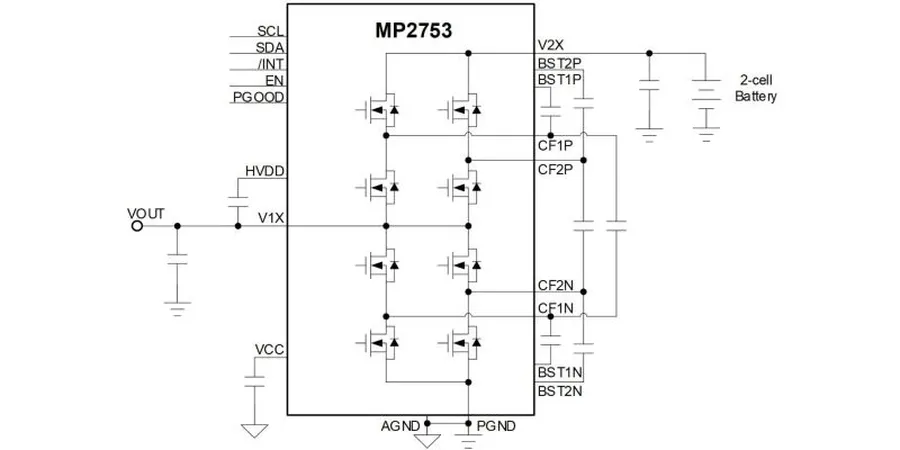
Switched capacitor converters utilize different circuit topologies to achieve varied voltage transformations. These configurations, such as voltage inverters, voltage doublers, and charge pumps, offer unique advantages and are chosen based on specific application requirements. Understanding these topologies is crucial for effective circuit design.
| Topology | Function | Description | Applications |
|---|---|---|---|
| Voltage Inverter | Inverts the polarity of the input voltage. | Produces a negative voltage from a positive input. Ideal for generating negative supply rails for op-amps or other circuits needing bipolar supplies. | Op-amp power supplies, RS-232 converters, negative bias generation |
| Voltage Doubler | Multiplies the input voltage by approximately two. | Achieves a higher output voltage than the input, efficient for low current applications. | LED drivers, low-power sensors, portable electronics |
| Charge Pump | Transfers charge between capacitors to increase or decrease voltage. | Versatile in generating different voltage levels. It uses switching and charge transfer to achieve desired voltage conversions. | Microprocessor voltage regulators, powering low power ICs, memory circuits |
These topologies often use MOSFET switches and capacitors to manipulate voltage levels. Their compact size, high efficiency, and relatively simple design make them ideal for numerous modern electronic applications, particularly those that are battery-powered or require a small form factor.
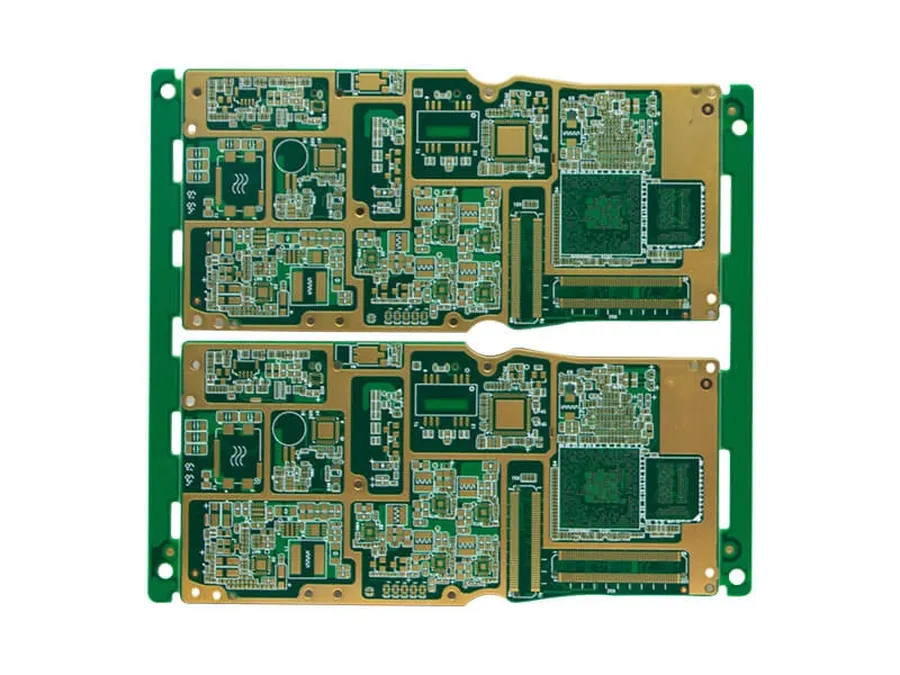
Capacitor converters, also known as switched capacitor converters or charge pumps, have become ubiquitous in modern electronics due to their efficiency, small size, and simplicity. These devices facilitate the conversion of voltage levels without the need for bulky inductors, making them ideal for portable and space-constrained applications. Their core function is to transfer energy between capacitors to achieve the desired voltage conversion.
Selecting the appropriate capacitor converter for a given application requires a careful analysis of several key factors. These include efficiency, size limitations, cost, and the desired voltage transformation ratio. A thorough understanding of these aspects is crucial to ensure optimal system performance and cost-effectiveness.
| Topology | Efficiency | Size | Cost | Voltage Transformation Ratio | Typical Applications |
|---|---|---|---|---|---|
| Voltage Inverter | Moderate | Small | Low | -1 | LCD bias, simple negative supply |
| Voltage Doubler | Moderate to High | Small to Medium | Low to Moderate | 2 | LED drivers, low-power boosting |
| Charge Pump | Moderate to High | Small to Medium | Low to Moderate | Integer ratios (e.g. 1/2, 2, 3/2 etc.) | Bias supplies for op-amps, powering small circuits |
| Fractional Converters | Moderate | Medium | Moderate | Fractional step up/down (e.g., 1.5, 0.67) | Advanced PMIC functions |
| Regulated Switched Capacitor Converters | High | Medium to Large | Moderate to High | Adjustable Voltage | Precise Voltage regulation, sensitive analog circuits |
Here's a deeper look at each of these critical factors:
This section addresses common questions regarding capacitor conversions and switched capacitor converters, providing clear, concise answers to enhance understanding and practical application.
Understanding capacitor conversions and the functionality of switched capacitor converters is vital for anyone delving into electronics. From accurately selecting components for circuits to designing efficient voltage transformations for portable devices, these fundamental concepts underpin modern technologies. By mastering these principles, one can unlock a deeper understanding of electronic systems and potentially innovate new applications in this crucial field of engineering. The ability to work with capacitor units and appreciate how capacitor voltage converters work is a useful skill in today's technology-driven world.

