Understanding the 2.2k Ohm Resistor: Applications, Color Code, and More
2025.01.29
In the realm of electronics, the 2.2k ohm resistor is a common component, as fundamental to circuit design as a building block is to architecture. From simple LED circuits to complex audio systems, this resistor plays a pivotal role in managing current flow and voltage levels. The 2.2k ohm resistor bridges the gap between theoretical circuit designs and the practical implementation of electronic devices. Let's explore what a 2.2k ohm resistor does and how it impacts electronic design and functionality.
What is a 2.2k Ohm Resistor?
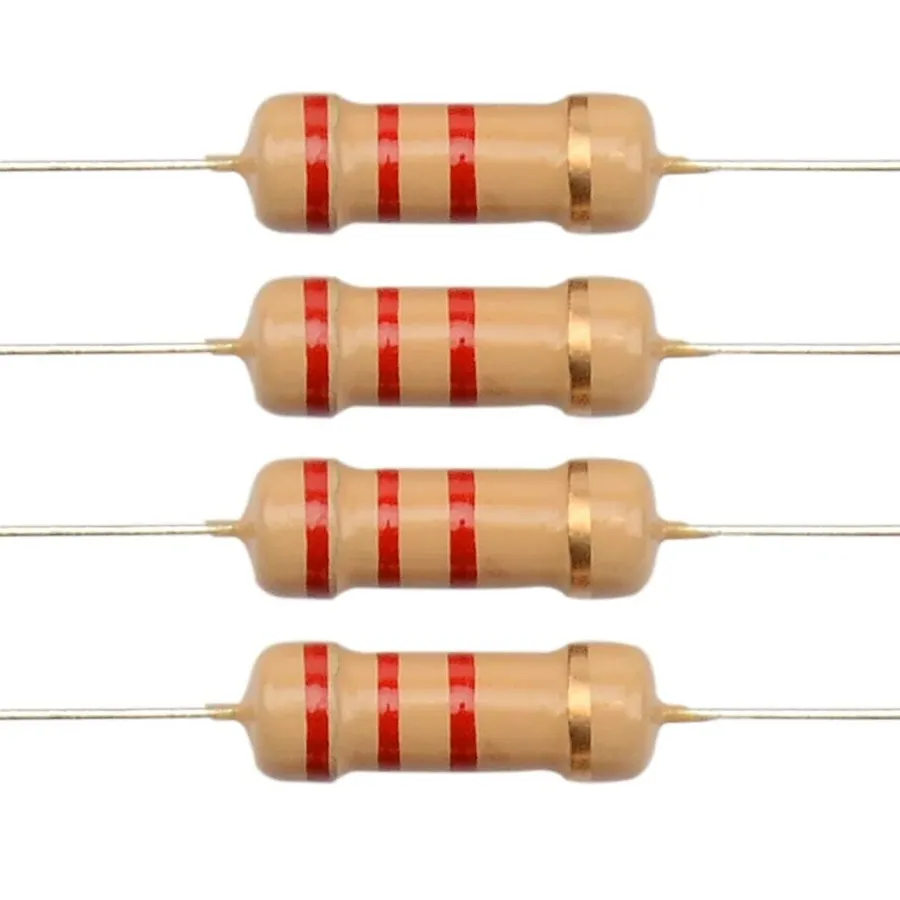
2.2k ohm resistor
A 2.2k ohm resistor, also denoted as a 2200-ohm resistor, is a fundamental electronic component characterized by its passive nature and two terminals. Its core function within a circuit is to impede the flow of electrical current, providing a specified resistance of 2200 ohms. This controlled resistance is crucial for manipulating both current and voltage levels, directly influencing the operational characteristics of electronic devices and systems. The 2.2k ohm resistor, therefore, plays a pivotal role in circuit design and performance.
2.2k Ohm Resistor Color Code
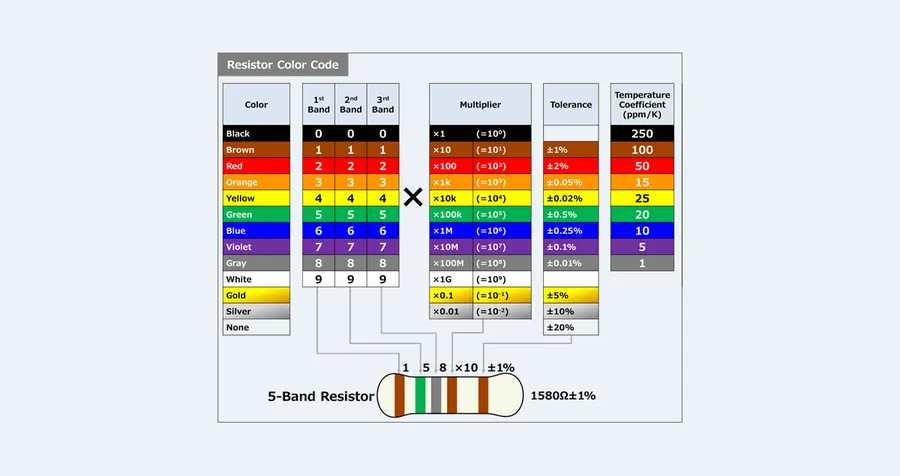
Resistor color code
The 2.2k ohm resistor's color code is a standardized system that uses colored bands to indicate its resistance value, multiplier, and tolerance. This system is crucial for identifying the correct resistor in electronic circuits, ensuring proper circuit behavior. For a 2.2k ohm resistor, the color bands are typically red, red, red, and gold, representing a resistance of 2200 ohms with a 5% tolerance.
Band
Color
Significance
1st Band
Red
First digit (2)
2nd Band
Red
Second digit (2)
3rd Band
Red
Multiplier (100, or 10^2)
4th Band
Gold
Tolerance (5%)
Typical Applications of a 2.2k Ohm Resistor
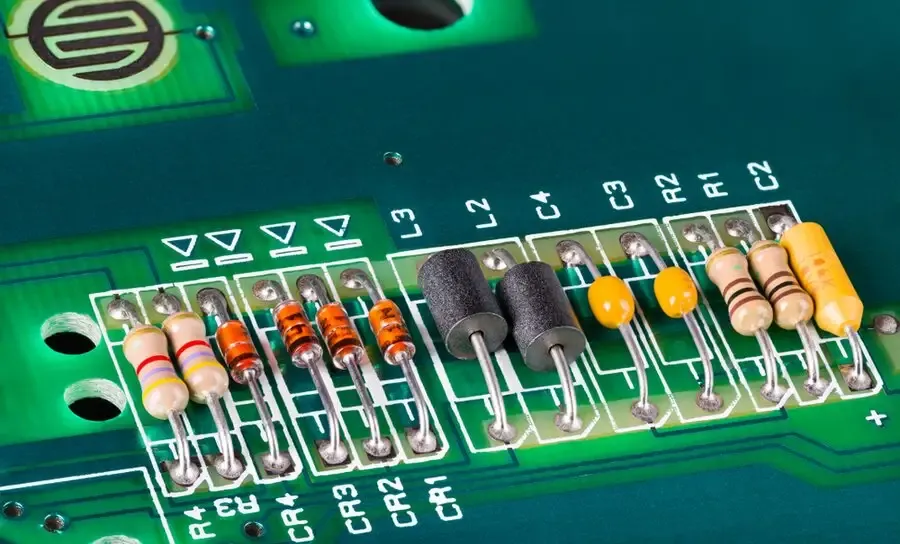
Resistor on PCB
The 2.2k ohm resistor serves as a versatile component in numerous electronic circuits, primarily for its ability to manage current and voltage levels. Its specific resistance value makes it suitable for a range of applications, including LED current control, digital circuit biasing, and voltage division.
LED Current Limiting A common use of the 2.2k ohm resistor is to limit current flowing through LEDs. LEDs are current-sensitive devices, and exceeding their rated current can damage or prematurely fail them. The 2.2k resistor, placed in series with an LED, limits the current to a safe operating level, prolonging the lifespan of the LED.
Pull-up and Pull-down Resistors In digital logic circuits, 2.2k ohm resistors are often employed as pull-up or pull-down resistors. These resistors establish a default logic state on an input pin when it's not being actively driven by another component. For example, a pull-up resistor will connect an input pin to a high voltage, ensuring the pin is in a high state when no other signal is present. A pull down resistor will connect the pin to ground. The 2.2k resistance offers a balance between current consumption and effective pull-up/down.
Voltage Dividers The 2.2k ohm resistor can be part of a voltage divider circuit, where multiple resistors are arranged in series to reduce a higher voltage to a lower voltage level. This is often required to power circuits that operate at lower voltages than are available in the power supply. By combining the 2.2k resistor with another resistor, a specific voltage drop can be achieved, which is calculable through simple resistor divider principles.
Signal Conditioning In signal conditioning applications, the 2.2k ohm resistor can be used to adjust the signal amplitude or impedance to make it compatible with other circuit components. This may involve creating a specific voltage drop for certain signal processing stages.
2.2k Resistor vs. Other Resistor Values
Various Resistors
The 2.2k ohm resistor is strategically positioned within the standard range of resistor values, making it suitable for medium resistance applications. Its value provides a balance between lower and higher resistance levels, offering specific characteristics in circuit design. Understanding its position relative to other values, such as the 2.2 ohm and 22k ohm resistors, is essential for proper circuit design.
Resistor Value
Resistance
Typical Application
Current Flow
2.2 Ohm Resistor
Low
Current Sensing, Shunt Resistors
High
2.2k Ohm Resistor
Medium
LED Current Limiting, Pull-up/Pull-down Resistors, Voltage Dividers
Medium
22k Ohm Resistor
High
High impedance applications, timing circuits
Low
The key difference between a 2.2 ohm, 2.2k ohm, and 22k ohm resistors lies in their resistance level and their impact on current flow in a circuit. A 2.2 ohm resistor has a much lower resistance, which means it will allow a higher current flow, while a 22k ohm resistor will have a much higher resistance, therefore impedes current flow more effectively. The 2.2k ohm resistor offers a middle ground, which is often required in many general electronics applications.
Selecting the Right 2.2k Ohm Resistor Type
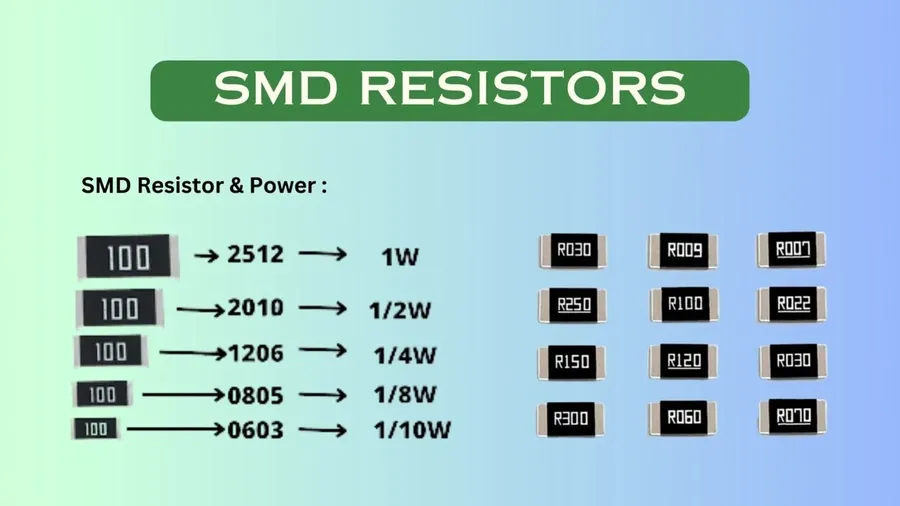
Resistor Packages
The selection of a 2.2k ohm resistor is not solely defined by its resistance value, but also by its physical construction and material properties. The optimal choice depends on a variety of factors, including the specific application's power handling needs, the required level of precision, and any constraints related to the physical dimensions of the circuit.
Resistor Type
Material
Tolerance
Power Rating
Temperature Coefficient
Applications
Advantages
Disadvantages
Carbon Film
Carbon composition
5% or 10%
Low to Medium
High
General-purpose circuits, hobbyist projects.
Cost-effective, readily available
Higher noise, lower precision and temperature stability.
Frequently Asked Questions About 2.2k Ohm Resistors
This section addresses common questions about 2.2k ohm resistors, providing clarity on their color codes, tolerances, and practical applications.
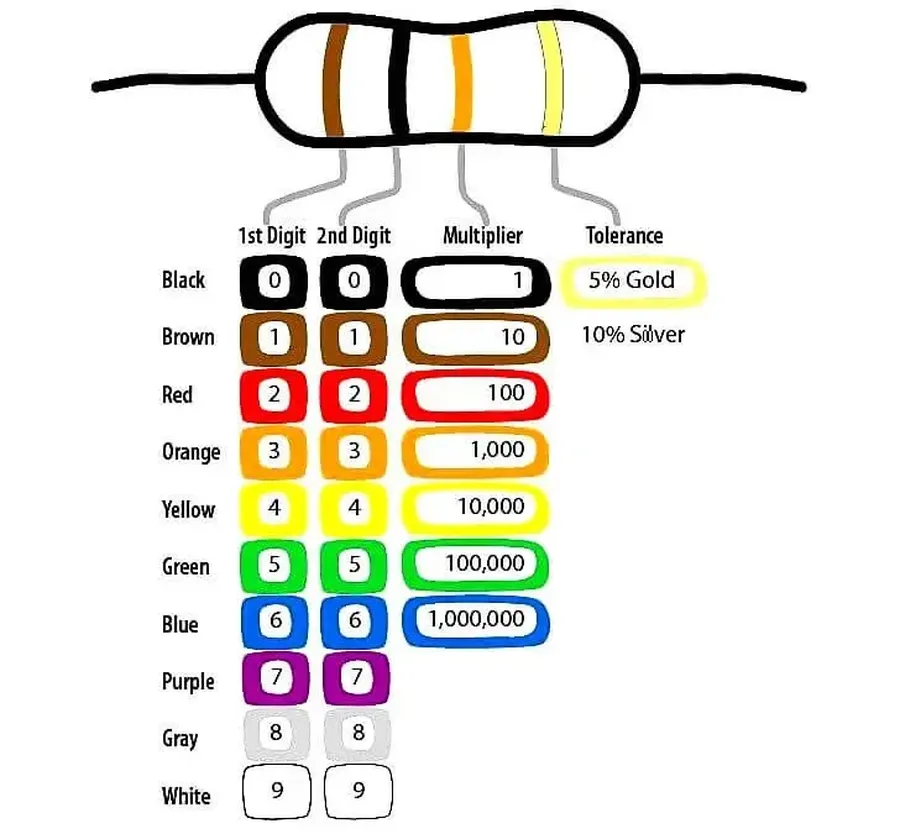
What is the color code for a 2.2k ohm resistor? The color code for a 2.2k ohm resistor is typically: Red, Red, Red, and Gold. The first two red bands represent the significant figures (2 and 2), the third red band is the multiplier (10^2 or 100), and the gold band indicates a 5% tolerance.
What does the tolerance band on a 2.2k ohm resistor mean? The tolerance band, often gold (5%) or silver (10%), indicates the permissible variation in the resistor's actual resistance value from its stated value. A 5% tolerance on a 2.2k ohm resistor means the actual resistance can range from 2.09k ohms to 2.31k ohms.
What is the function of a 2.2k ohm resistor in a circuit? A 2.2k ohm resistor's primary function is to limit the current flow in a circuit and to establish a specific voltage drop as defined by Ohm's law. It is commonly used for setting bias conditions, current limiting for LEDs, and configuring voltage dividers.
How can I calculate the voltage drop across a 2.2k ohm resistor? Using Ohm's Law (V = IR), where V is voltage, I is current, and R is resistance, the voltage drop across a 2.2k ohm resistor can be calculated by multiplying the current flowing through it by its resistance (2200 ohms). This helps in designing circuits with appropriate voltage and current distribution.
How does a 2.2k ohm resistor compare to a 2.2 ohm resistor? A 2.2k ohm resistor offers significantly higher resistance compared to a 2.2 ohm resistor (2200 ohms vs 2.2 ohms). This difference means a 2.2k ohm resistor will restrict current flow much more than a 2.2 ohm resistor, and it will cause a larger voltage drop for the same current.
Can a 2.2k ohm resistor be used as a pull-up or pull-down resistor? Yes, a 2.2k ohm resistor is often used as a pull-up or pull-down resistor in digital logic circuits. These resistors help to define the default state of a digital input pin when it's not actively driven by a signal.
What are the common wattage ratings for 2.2k ohm resistors? Common wattage ratings for 2.2k ohm resistors include 1/8 watt, 1/4 watt, and 1/2 watt. The appropriate wattage should be selected based on the power dissipation expected in the circuit to avoid overheating and damage to the component. Remember to calculate power using P=I^2*R or P=V^2/R.
Practical Tips for Using 2.2k Ohm Resistors
Breadboard Circuit
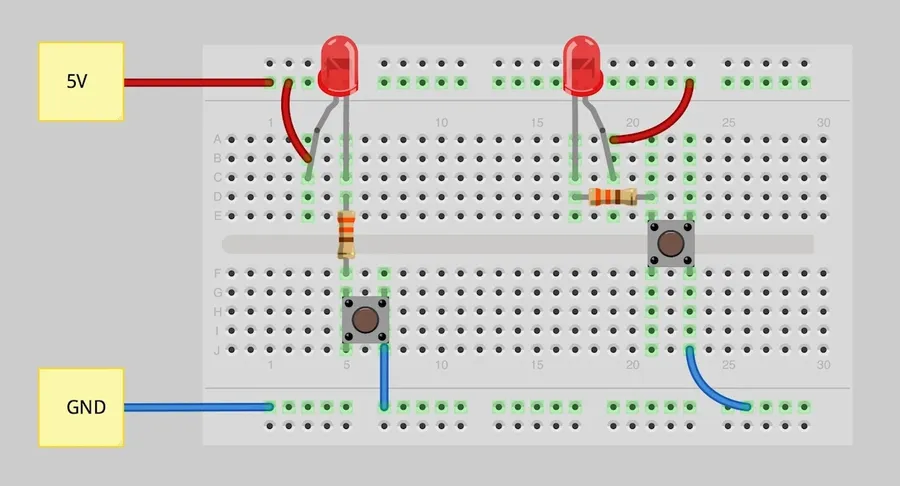
Proper handling and application of a 2.2k ohm resistor are essential for ensuring the performance and longevity of electronic circuits. This involves not only correctly identifying the resistor but also accounting for its operational limits and the circuit's environmental conditions.
Heat Dissipation Resistors generate heat when current flows through them. Ensure adequate ventilation and heat dissipation, especially in high-current applications. Overheating can cause the resistor to fail or change its resistance value.
Voltage and Current Ratings Always adhere to the voltage and current ratings specified for the 2.2k ohm resistor. Exceeding these limits can lead to resistor burnout or damage to the circuit. These ratings are typically provided in the resistor's datasheet.
Correct Placement Ensure that the resistor is correctly placed in the circuit according to the schematic. Misplacing a resistor can alter the circuit's intended function and possibly cause damage. Double check your connections.
Color Code Verification Before installation, always double-check the color bands to confirm the 2.2k ohm resistance value. Even a slight misreading can result in circuit malfunction. Red-Red-Red-Gold is the specific combination for a 2.2k ohm resistor.
Environmental Conditions Consider the environmental conditions in which the circuit will operate. Extreme temperatures or humidity may affect the performance and life span of the resistor. Select resistors with appropriate temperature coefficients where needed.
2.2k Ohm Resistor and Ohm's Law
The 2.2k ohm resistor's behavior within a circuit is fundamentally governed by Ohm's Law, a cornerstone of electrical engineering. This law, expressed as V = IR, establishes a direct relationship between voltage (V), current (I), and resistance (R). The 2.2k ohm resistor, with its fixed resistance value, dictates how much current will flow for a given voltage applied, or conversely, what the voltage drop will be across it for a given current.
Understanding and correctly applying Ohm's Law when working with 2.2k ohm resistors is critical for circuit design and troubleshooting. It allows engineers to calculate expected voltage drops or current flows, ensuring components operate within their rated parameters, preventing damage, and achieving desired circuit functionality.
Variable
Description
Units
V
Voltage
Volts (V)
I
Current
Amperes (A)
R
Resistance
Ohms (Ω)
Key Applications of Ohm's Law with 2.2k Ohm Resistors:
Current Limiting Using Ohm's Law, one can determine the appropriate 2.2k resistor value to limit the current in a circuit, such as for an LED. For instance, given a known voltage source and an LED's required operating current, the 2.2k ohm resistor can be chosen to ensure the LED receives the correct current without being damaged.
Voltage Division Ohm's Law, along with the principle of series resistors, allows the 2.2k ohm resistor to function within a voltage divider. This circuit can be used to derive a lower voltage from a higher one. By combining the 2.2k ohm resistor with other resistors, precise voltage levels can be obtained. This approach is invaluable in sensor circuits and other signal processing applications.
Calculating Voltage Drops By knowing the current passing through a 2.2k ohm resistor, Ohm's Law (V = IR) directly calculates the voltage drop across it. This is crucial for understanding how voltage is distributed within a circuit and for predicting the voltage at different points of an electronic system.
The 2.2k ohm resistor may seem like a small component, but it plays a huge role in circuit functionality, demonstrating the power of a simple component like the 2.2k resistor. This exploration shows how these resistors are integral to controlling current and voltage in circuits. Understanding the 2.2k resistor's color code, applications, and practical usage ensures better performance for any electronics project. Like a good chef knowing how much seasoning to use, understanding the 2.2k resistor will improve your circuits.